

The S&P 500 reached record highs in August, highlighting the market’s resilience during the third quarter of 2026. Beneath those gains, however, renewed conflict in the Middle East, rising interest rates and the Federal Reserve’s first rate hike since 2023 created a bumpier backdrop, while bonds faced a difficult quarter. With the final stretch of the year underway, we look back at what drove markets and consider what may shape the months ahead.
Key Takeaways
- Rates took center stage: The Fed raised rates for the first time since 2023 and the 10-year Treasury yield climbed to its highest level since 2002. Bond values fell, while the S&P 500 still gained 2.3%.
- Diversification looked different: Stocks and bonds fell together in September and the asset class that helped most was commodities, up 16.2% as oil prices climbed roughly 30%—a reminder that different diversifiers work in different environments.
- Looking ahead: Earnings remain the market’s strongest support and valuations are less stretched than at midyear, but the Fed, oil prices and the November midterm elections could all bring bouts of volatility.
A Choppy Start, a Muted Finish
The quarter got off to an uneasy start. In early July, the June ceasefire between the U.S. and Iran broke down, sending oil prices sharply higher. At the same time, AI-related chip stocks hit a rough patch as investors questioned how long the boom in AI spending could last. South Korean memory chipmaker SK Hynix, for example, suffered its biggest one-day drop in nearly two decades in mid-July, according to Reuters. Stocks soon steadied, helped by a strong earnings season: S&P 500 earnings grew roughly 52% from a year earlier in the second quarter, more than double the 23% growth analysts expected when the quarter ended, according to FactSet. The S&P 500 went on to close at a record high in mid-August.
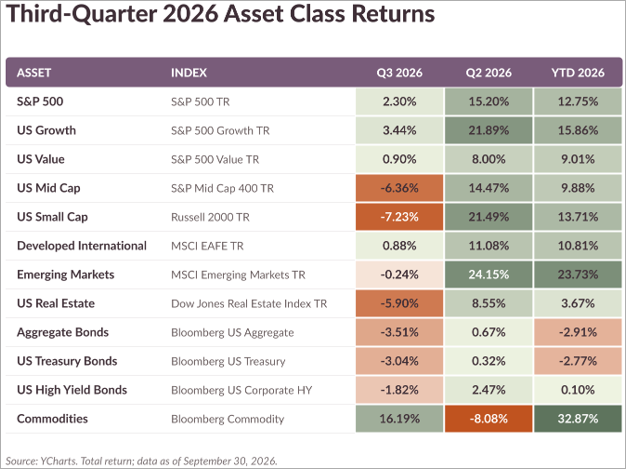
September brought a change in tone: interest rates climbed and stocks and bonds fell together. On a total return basis, the S&P 500 gained 2.3% for the quarter and is up 12.8% year to date. Gains were narrow: growth stocks led with a 3.4% return, followed by value and developed international stocks (+0.9% each). Small cap stocks (-7.2%), mid cap stocks (-6.4%), and real estate (-5.9%) were the weakest asset classes.
Rates Took Center Stage
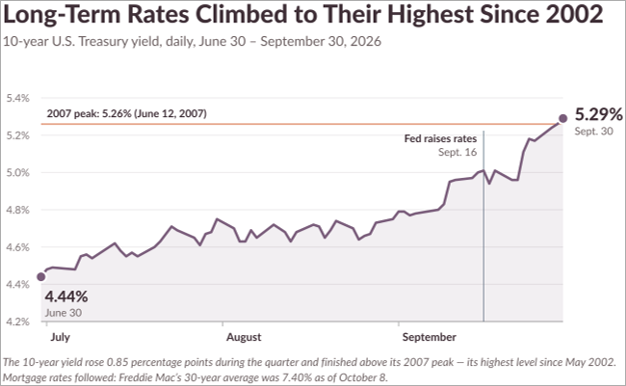
Rising interest rates were the defining story of the quarter. In August, consumer prices were up 3.4% from a year earlier, well above the Fed’s 2% inflation target. On September 16, policymakers voted 12-0 to raise the federal funds target range by a quarter point to 3.75%–4.00%, the first increase since July 2023. “This summer’s inflation readings do not tell me that underlying trends have meaningfully improved,” Fed Chair Kevin Warsh said. Projections released with the decision showed 16 of 18 officials expecting at least one more increase before year end.
Long-term rates rose even more. The 10-year Treasury yield climbed from 4.44% to 5.29%, ending the quarter above its 2007 peak and at its highest level since 2002. PIMCO Group Chief Investment Officer Dan Ivascyn pointed to high oil prices, worries over the growing federal debt and forced selling by hedge funds and other leveraged investors. Higher rates are reaching households, too: Freddie Mac’s 30-year mortgage average rose to 7.40% as of October 8, the highest since November 2023.
For bond investors, rising yields mean falling prices in the short run. The broad U.S. investment-grade bond market (Bloomberg U.S. Aggregate) lost 3.5% for the quarter and is down 2.9% year to date. The silver lining, as we discussed in our recent look at the bond market, is that today’s higher yields mean more income from new purchases and reinvestments going forward.
Diversification Looked Different This Quarter
Bonds have long been the ballast in a balanced portfolio and they held steady during the first quarter sell-off. In September, though, stocks and bonds fell together. That isn’t unprecedented. When inflation runs high, as it did in 2022, stocks and bonds tend to move more closely together. The asset class that helped most this quarter was commodities: the Bloomberg Commodity Index gained 16.2% as oil prices climbed roughly 30%.
Leadership within stocks rotated as several of the second quarter’s leaders lagged: small cap stocks (Russell 2000) fell 7.2% and emerging market stocks slipped 0.2% after gaining 24.0% in the second quarter.
The lesson is that no single diversifier works in every environment. Owning a mix of company sizes, styles, regions and asset types—including real assets such as commodities—can help smooth the ride.
Earnings Did the Heavy Lifting
Corporate profits remain the market’s engine. According to FactSet’s October 9 data, S&P 500 companies are expected to report third-quarter earnings growth of 29.6%, up from 26.7% when the quarter began, which would mark a third straight quarter above 25%. That upward revision is unusual, since analysts typically trim estimates as a quarter unfolds. Meanwhile, 72 companies issued positive earnings guidance for the quarter, the most since FactSet began tracking in 2006.
Technology companies tied to AI remain the biggest driver. The technology sector is expected to grow earnings 65.1%, led by semiconductor companies at roughly 130%. Energy is expected to post the fastest growth of the 11 sectors, 121.1%, on higher oil prices.
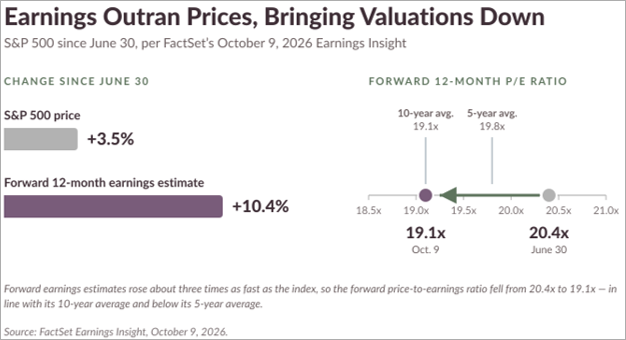
Because expected profits have grown faster than share prices, stocks have become less expensive. From June 30 through early October, forward 12-month earnings estimates for the S&P 500 rose 10.4% while the index gained 3.5%, pulling the forward price-to-earnings ratio down to 19.1 from 20.4, in line with its 10-year average, according to FactSet.
Looking Ahead: What We’re Watching in the Fourth Quarter
We enter the final quarter constructive but watchful. Earnings are strong, valuations are more reasonable than at mid-year and analysts expect earnings growth of about 28% in the fourth quarter and 16% in 2027. A few things could test that backdrop:
- The Fed (decisions on October 28 and December 9): Policymakers must weigh inflation that remains well above target against a cooling job market. The economy added just 29,000 jobs in September, unemployment edged up to 4.2% and revisions trimmed a combined 60,000 jobs from July and August.
- Long-term rates: With the 10-year yield above 5%, a move to 5.5% or higher could potentially cause some weakness in risk markets, both credit and equity.
- Oil and the Middle East: Energy prices remain tied to developments involving Iran and the Strait of Hormuz, and they feed directly into inflation.
- The midterm elections: Midterm years have tended to bring below-average returns and higher volatility, with volatility often peaking just before the vote, according to Ameriprise. Since 1950, though, the S&P 500 has gained an average of 15.4% in the year after a midterm election.
While we follow this short-term information closely to manage portfolios, we continue to take the long-term view when it comes to your financial picture. The third quarter was a reminder that leadership can rotate quickly and the biggest risk during turbulent stretches is often the temptation to react to the headlines. While no one can predict how markets will behave over the coming months, maintaining a diversified portfolio, rebalancing thoughtfully and keeping your investment strategy aligned with your long-term goals remain some of the most effective ways to navigate changing market conditions.
If you have questions about the markets, your portfolio or how any of this fits into your broader financial plan, please reach out to your financial planner. We’re happy to connect.
Johnson Bixby is an independent financial planning and investment management firm serving individuals, families and couples throughout Southwest Washington, the Portland, Oregon, metro area and beyond. The firm is a fiduciary that provides comprehensive financial planning tailored to each client’s unique goals, including retirement planning, investment management, tax planning strategies, estate planning, charitable planning and other important financial decisions.





































0 Comments