

For most investors, bonds are the quiet part of the portfolio. They don’t grab headlines like a hot tech stock or a record run in gold. They pay their interest and help keep things steady when stocks get bumpy. So when bonds start leading the evening news, it’s natural to wonder what’s going on and what it means for you. In this post, we’ll explain how bonds work, why the bond market has been in the spotlight and why higher interest rates aren’t all bad news for long-term investors.
Why Bonds Are Making Headlines
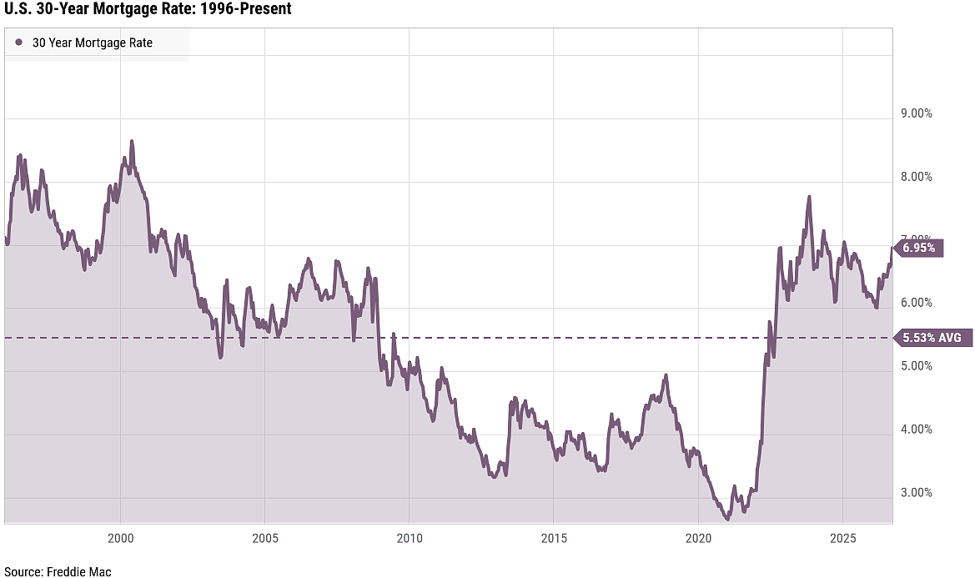
On September 16, the Federal Reserve raised its benchmark interest rate by a quarter point to a range of 3.75% to 4.0%, its first increase since July 2023. That same week, the 10-year Treasury yield, a key benchmark for mortgages and other long-term borrowing, topped 5%, its highest level since 2007. The average 30-year fixed mortgage rate recently reached 6.95%, a 19-month high.
What’s Pushing Rates Higher?
The first factor is inflation. Consumer prices rose 4.2% over the 12 months ending in May, the largest annual increase since 2023, driven largely by a 23.5% jump in energy prices. Inflation has since eased to 3.4% as of August, but that’s still well above the Fed’s 2.0% target. When prices rise, investors want to be paid more to lend money for 10 or 30 years, because inflation eats away at the value of those future interest payments.
The second is supply. The Congressional Budget Office projected a $1.9 trillion federal deficit for fiscal year 2026, or 5.8% of the economy, well above the 3.8% average of the past 50 years. The government covers that gap by selling bonds, and when the supply of bonds grows faster than demand, prices tend to fall and yields rise.
The third is corporate borrowing. Companies have been issuing bonds at a rapid pace, driven in part by large technology firms starting to borrow to fund artificial intelligence projects. That adds even more bonds to the market.
The bond market doesn’t get as much attention as the stock market, but its influence is wide-reaching. When bond yields move, the ripple effects show up in mortgage rates, business loans and even stock prices.
Bonds 101: What You’re Actually Buying
At its core, a bond is a loan. It can be a loan to a government, a city or a company. In return, the borrower promises to pay you interest (called the coupon) on a regular schedule and to return your original investment (the face value) on a set date (the maturity date).
Bonds come in several varieties. U.S. Treasuries are backed by the full faith and credit of the federal government. Municipal bonds are issued by states and local governments, and their interest is often exempt from federal income tax. Corporate bonds are issued by companies and typically pay more interest to make up for the added risk that the company could struggle to repay. Credit rating agencies grade borrowers on their ability to repay, and generally, the lower the rating, the higher the interest rate a borrower must offer.
The Bond Teeter-Totter
The single most important thing to glean regarding bonds is that prices and interest rates move in opposite directions. Picture two people on a playground teeter-totter—when one side goes up, the other goes down.
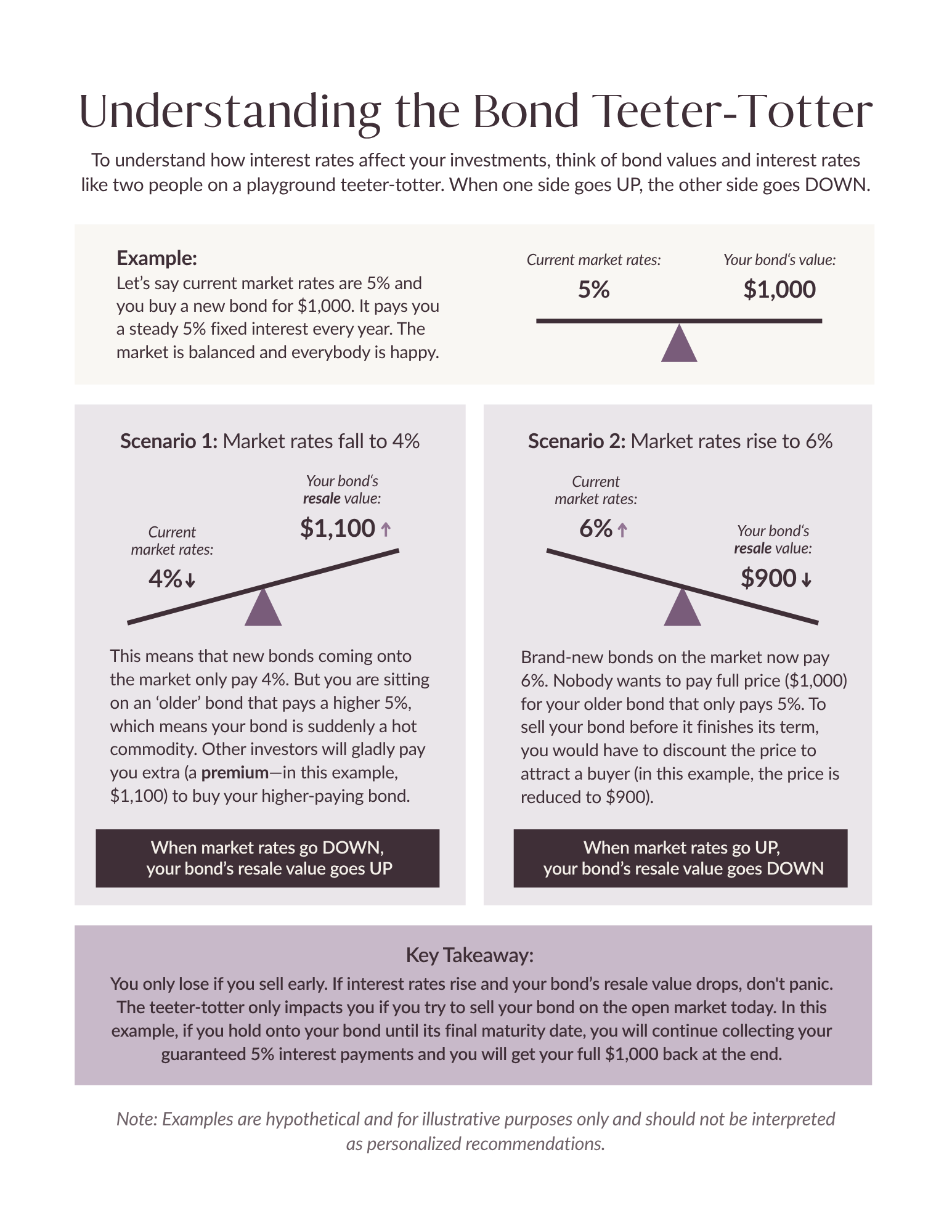
Here’s a hypothetical example. Say market rates are 5% and you buy a new 15-year $1,000 bond that pays a fixed 5% each year. If rates fall to 4%, your bond pays more than new ones, so with about 14 years left until maturity, a buyer would pay roughly $1,100 for it, a premium over face value. If rates instead rise to 6%, new bonds pay more than yours, and you would need to lower the price to roughly $900 to sell it before it matures.
How far the teeter-totter tips depends largely on how much time is left until the bond matures. In our example, a bond with one year left would move only about $10, while one with 30 years left would swing by roughly $140 to $175. Professionals refer to this price sensitivity as duration.
The key takeaway: a price drop on paper only becomes a real loss if you sell before maturity. If you hold the bond until it matures and the issuer makes its payments as promised, you’ll keep collecting your 5% interest and get your full $1,000 back.
This example is hypothetical, for illustrative purposes only, and assumes interest is paid twice a year. It does not represent any specific investment.
What About Bond Funds?
Many investors own bonds through ETFs and mutual funds, which work a little different. Most bond funds don’t have a maturity date, so there’s no set date when you get your original investment back and their share prices typically fall when rates rise. The upside is that the fund reinvests maturing bonds at today’s higher rates and over time that added income can help offset the decline.
The Silver Lining of Higher Rates
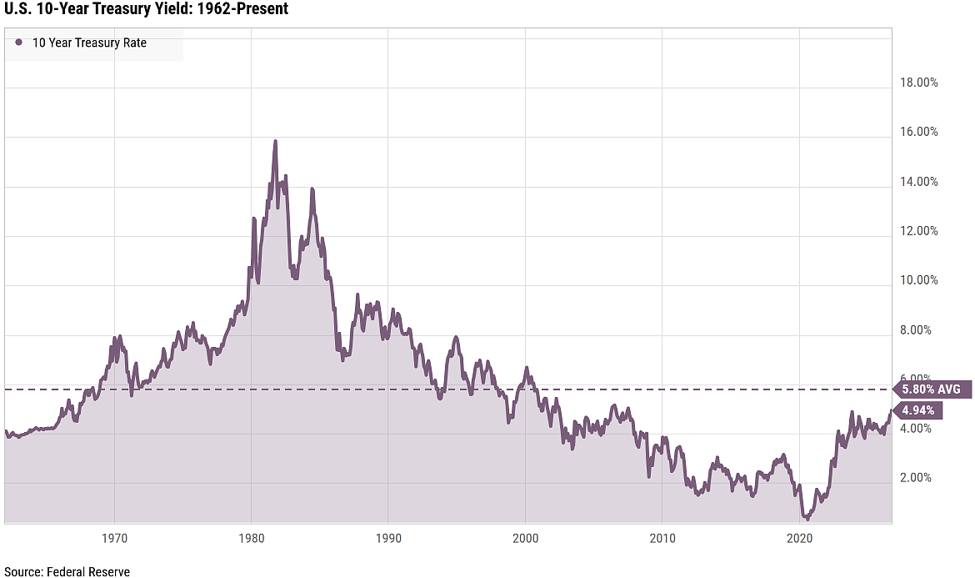
Headlines about rising rates can sound alarming, but it helps to zoom out. The 10-year Treasury yield has ranged from nearly 16% in 1981 to roughly half a percent in 2020 and it has averaged about 5.8% since 1962. The unusually low rates of the 2010s and early 2020s were the exception, not the rule. Seen in that light, today’s rates look closer to historical norms than to a crisis.
Higher yields are also good news for anyone investing new money or reinvesting maturing bonds. After years of paying very little, high-quality bonds offer meaningful income again—the kind that may help fund retirement spending without relying as heavily on stocks.
There are reassuring signs beneath the surface, too. Market-based measures of longer-term inflation expectations were around 2.3% in mid-September, suggesting investors expect inflation to cool. And the extra yield on investment-grade corporate bonds over Treasuries remains near a 25-year low—a sign the market isn’t bracing for widespread defaults.
Why Bonds Belong in a Diversified Portfolio
Bonds provide steady income, help cushion a portfolio when the stock market falls and give investors a stable source of cash to draw from during a downturn instead of selling stocks at a low point.
That doesn’t mean bonds are without risk. Inflation erodes the buying power of fixed-interest payments, lower-quality bonds carry a greater risk of default and prices can fall sharply when rates climb quickly. In 2022, the Bloomberg U.S. Aggregate Bond Index lost about 13%, its worst calendar year on record. That’s why the types of bonds you own, their maturities and how they fit your overall portfolio all matter.
Are Bonds Right for You?
The bond market will keep responding to news about inflation, the Fed and government spending. What matters most is how bonds fit your personal goals, time horizon and need for income. If recent headlines have you wondering about your bond allocation, your financial planner can walk you through how it’s positioned and how it fits into your long-term plan.
Johnson Bixby is an independent financial planning and investment management firm serving individuals, families and couples throughout Southwest Washington, the Portland, Oregon, metro area and beyond. The firm is a fiduciary that provides comprehensive financial planning tailored to each client’s unique goals, including retirement planning, investment management, tax planning strategies, estate planning, charitable planning and other important financial decisions.





































0 Comments