

Last year’s passage of the One Big Beautiful Bill Act (OBBBA) introduced several tax law changes that could affect individuals and families. Among them is the creation of Section 530A accounts—more commonly known as Trump Accounts—a new savings option designed to help families invest for a child’s future.
As with any new financial planning tool, it’s important to understand how it works, who may benefit and how it compares with existing savings options. In this article, we’ll cover the basics of Trump Accounts, explore their potential advantages and limitations and discuss key considerations to help you determine whether they may be a good fit for saving for a child or grandchild.
Key Takeaways
- A new tax-advantaged account that allows families to begin saving for a child’s future from birth.
- Starting early gives investments more time to benefit from compound growth.
- The accounts are designed to help families start saving and investing for a child’s future early, using a familiar retirement-account framework.
- Children born from January 1, 2025, through December 31, 2028, are eligible for $1,000 starter contribution from the government.
What are Trump Accounts?
Section 530A Trump Accounts are new tax-advantaged accounts that allow families to start saving for their children’s future expenses, including education, a first home purchase or long-term retirement savings. They combine features of 529 plans and Individual Retirement Accounts (IRAs), although they follow their own rules and restrictions.
These accounts became available on July 5, 2026.
Who’s Eligible for the New Trump Accounts?
U.S. children under age 18 with a valid Social Security Number are eligible for Section 530A accounts. The account operates in a custodial-style structure. The child owns the assets, while a parent or legal guardian manages the account until the child is 18. Children born between January 1, 2025, and December 31, 2028, are eligible to receive a $1,000 starter contribution from the U.S. government as part of the federal pilot program1
How Do Trump Accounts Work?
Parents, guardians, employers, charities, government entities, and in some cases the child, may contribute to the account.
Annual contributions are limited to $5,000. Initial investment options include low-cost funds that track U.S. stock indexes, like the S&P 500. Additional low-cost investment options may become available over time, expanding diversification opportunities.2
Investments grow tax-deferred, allowing compound growth over many years. Starting early gives savings more time to potentially grow into a meaningful financial resource.
What Happens When a Child Turns 18?
In general, funds remain invested until the year the child turns 18. Once the beneficiary turns 18, the account is treated like a traditional IRA for tax purposes. At that point, the child can choose to continue using it for long-term savings or make withdrawals under traditional IRA rules, meaning they’d generally be subject to ordinary income tax on any amount withdrawn above the amount of total contributions.
Withdrawals made before age 59½ may also be subject to a 10% early withdrawal penalty. However, there are exceptions including first-time homebuyers and funds used on qualified education and medical expenses.
After age 59½, funds can be withdrawn for any purpose without penalty (income tax would still apply). These rules reinforce that Trump Accounts are intended primarily for long-term savings.
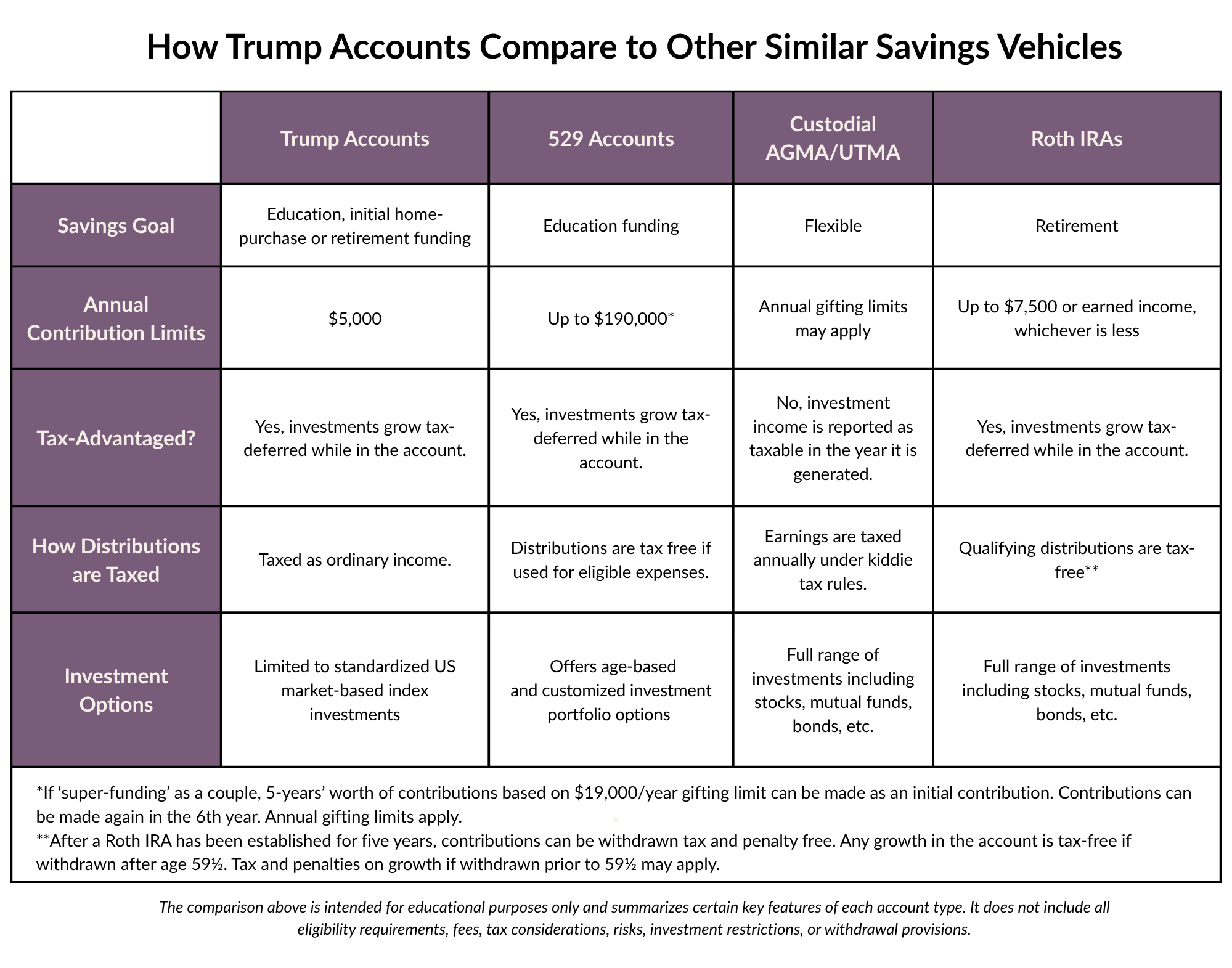
A Few Important Things to Consider
- One key difference between Trump Accounts and IRAs or Roth IRAs is that Trump Accounts do not require the beneficiary to have earned income, allowing parents or others to begin funding an account for a child from an early age.
- A fully funded account has the potential to grow substantially over 18 years. While that can provide a meaningful financial headstart, some parents may be uncomfortable with their child gaining control of the account at age 18.
- Although Trump Accounts can be a valuable savings tool, they won’t be the right fit for every family.
Families should weigh the account’s contribution limits, investment options, tax treatment, withdrawal rules and age-based restrictions alongside other available savings vehicles. Understanding these tradeoffs can help determine whether a Trump Account aligns with your priorities and timeline. Because every family’s financial goals are unique, a Trump Account should be considered as one piece of a broader financial plan—not in isolation. Whether you’re saving for education, building long-term retirement assets, helping fund a first home or balancing multiple priorities, a financial planner can help you compare your options and build a strategy that supports your family’s long-term goals.
- $1,000 contribution to children born from 01/01/25 – 12/31/28 https://www.irs.gov/trumpaccounts ↩︎
- Initial investment options https://home.treasury.gov/news/press-releases/sb0551 ↩︎





































0 Comments