

Many people envision early retirement as walking away from work and immediately enjoying the freedom they’ve spent decades saving up for. But once someone starts seriously considering retirement in their 50s, one question often comes up: “How do I access my retirement savings before age 59½?”
If you’re in this camp and you’re asking yourself this question, good! You should be, because most retirement accounts carry a 10% early-withdrawal penalty when funds are taken before age 59½. Not an ideal tax situation. Fortunately, there are a few exceptions that may provide flexibility for early retirees. Two of the most common are the Rule of 55 and 72(t) substantially equal periodic payments (SoSEPPs).
The important word is may. These strategies can be valuable in the right circumstances, but both require careful planning.
Key Takeaways
- The Rule of 55 may allow penalty-free withdrawals from the 401(k) or 403(b) of the employer you leave during or after the calendar year you turn 55; qualified public safety employees may qualify at 50.
- The Rule of 55 applies only to the qualifying employer plan—not an IRA—and rolling the account to an IRA may eliminate exemptions.
- A 72(t) arrangement may provide penalty-free access at any age through substantially equal periodic payments, often using IRA assets.
- Once 72(t) payments begin, they generally must continue for at least five years or until age 59½, whichever is longer; improper changes may trigger retroactive penalties and interest.
- The Rule of 55 generally offers more withdrawal flexibility, while 72(t) may work for earlier retirees but requires a rigid schedule and careful planning.
The Rule of 55
The Rule of 55 allows some workers to access funds from their current employer’s 401(k) or 403(b) without the normal 10% early-withdrawal penalty if they separate from service during or after the calendar year they turn 55. Ordinary income taxes still apply to withdrawals.
For example, someone who leaves an employer at age 56 may be able to draw from that employer’s retirement plan immediately without waiting until age 59½.
However, there are several limitations:
- The rule generally applies only to the employer plan you’re leaving.
- It does not apply to IRAs or Roth IRAs.
- Rolling the account into an IRA can eliminate eligibility.
- Some retirement plans may have limited withdrawal options even if IRS rules allow the exception. E.g. – Some plans may impose a minimum withdrawal amount, a mandatory tax withholding percentage, and/or a fee per distribution.
Because of these restrictions, planning before leaving an employer is critical.
Understanding 72(t) Distributions
Another option is a strategy known as a 72(t) or substantially equal periodic payments (SoSEPPs) plan. Under IRS rules, individuals can avoid the early-withdrawal penalty by committing to a series of substantially equal periodic payments calculated using approved IRS methods.
While this creates access to retirement savings before age 59½, there’s a catch:
Once the schedule is established, payments generally must continue for at least five years or until age 59½, whichever is longer. Modifying the schedule incorrectly or taking a one-time distribution outside of your SoSEPP schedule can trigger retroactive penalties and interest, also known as blowing up the plan.
Curious what the IRS criteria are for establishing 72(t) distributions? Well, per IRS Notice 2022-6, there are currently three methods:
- The Required Minimum Distribution (RMD) method
- The fixed amortization method
- The fixed annuitization method
It’s best to know what amount of income you think you’ll need, then run the numbers on all three methods to see which best aligns with your needs. But be careful—all three require identifying the proper IRS life expectancy table and for the fixed options (number 2 & 3), settling on an appropriate interest rate needed for the calculations.
In other words, 72(t) can provide you access, but not necessarily flexibility.
Which Strategy May Be Appropriate?
The answer depends on your situation.
The Rule of 55 tends to be simpler when available because it doesn’t require a rigid payment schedule. For someone leaving an employer at 55, 56, or 57, it can provide flexibility to take earlier account withdrawals if they’re needed.
72(t) arrangements can be useful for retirees who left employment earlier or who primarily have assets in IRAs, but they require more ongoing administration and discipline.
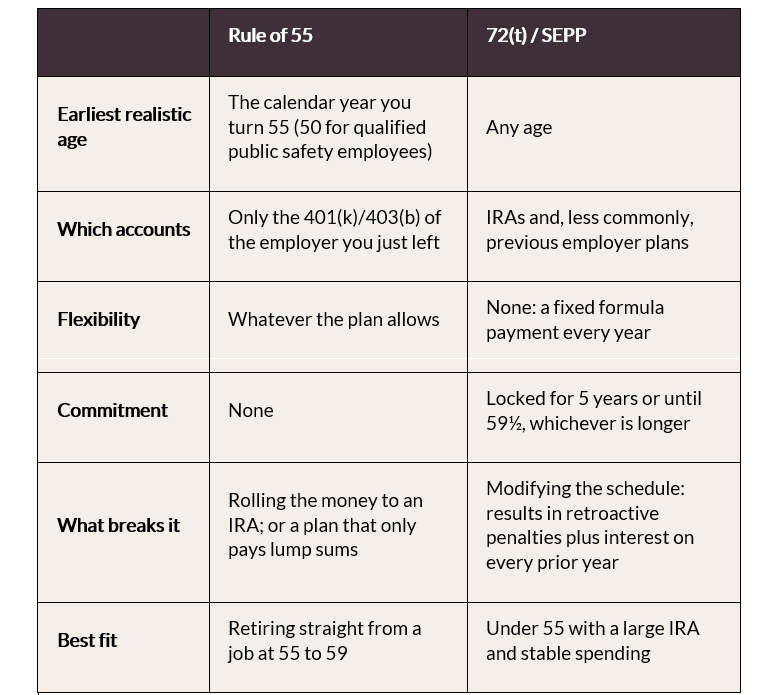
Rule of 55 vs. 72(t)
While the goal is similar, these two options aren’t interchangeable, and the right one is mostly determined by your age and where the money sits.
Don’t Forget the Bigger Picture
Finding a way to access a retirement account is only one piece of the early-retirement puzzle.
Healthcare costs before Medicare eligibility, portfolio sustainability, market volatility, and future Social Security decisions can all significantly affect whether an early retirement remains successful over the long term. And this assumes you’ve already thought of What you’re retiring “to”, not just what you’re retiring “from”!
The goal isn’t simply to retire early. The goal is to retire early with confidence that your plan is sustainable.
Final Thoughts
Accessing retirement accounts before age 59½ is often possible but isn’t always straightforward. The Rule of 55 and 72(t) strategies can create flexibility for early retirees, yet mistakes can be costly.
Before implementing either strategy, it’s worth evaluating how withdrawals fit into your broader retirement income plan, tax picture, and long-term goals.
Related Reading: Rethinking Retirement: Earlier, Later, or Somewhere in Between
Zach Reuter, is a CERTIFIED FINANCIAL PLANNER® professional at Johnson Bixby. His work focuses on retirement planning, tax planning strategies, inheritance planning, employee benefits analysis, and college funding strategies for individuals and families.





































0 Comments