

For many people, giving to charity is an important part of their financial plan. But as retirement brings new considerations around Required Minimum Distributions (RMD), taxes and income, it can be worth looking at how you give—not just how much.
A Qualified Charitable Distribution (QCD) offers an opportunity for eligible Individual Retirement Account (IRA) owners to give RMDs directly to qualified charities while potentially reducing taxable income. And despite the tax rules behind it, the process can be surprisingly simple.
If you’re 70½ or older and regularly support charitable organizations, a QCD may be a strategy worth understanding as you plan for your retirement, taxes and the impact to your cash flow.
Key Takeaways
- QCDs have helped retirees give directly from their IRAs to charity since 2006, combining charitable giving with tax-efficient retirement planning.
- Congress made QCDs permanent in 2015, and SECURE 2.0 expanded their usefulness by indexing annual limits for inflation and adding new charitable planning opportunities.
- For eligible taxpayers, a QCD may satisfy all or part of a RMD while allowing the qualified distribution amount to be excluded from federal taxable income, subject to IRS requirements.
- Many custodians make the process remarkably simple, allowing eligible individuals to write checks directly from a designated IRA checkbook or initiate transfers to qualified charities.
Why use Qualified Charitable Distributions?
For many retirees, charitable giving is about more than tax savings. It’s about supporting organizations and causes that they care about.
Qualified Charitable Distributions have become one of the most effective ways to accomplish both goals. Since their creation nearly two decades ago, QCDs allow eligible IRA owners to make charitable gifts directly from their retirement accounts to the charity while potentially reducing taxable income.
Although the rules surrounding retirement accounts continue to evolve, QCDs have remained one of the most valuable planning opportunities available to charitably inclined retirees.
The History of Qualified Charitable Distributions
Congress established Qualified Charitable Distributions as part of the Pension Protection Act of 2006. The original provision allowed individuals age 70½ or older to transfer money directly from an IRA to a qualified public charity without including that distribution in taxable income.
Initially, the legislation was temporary. Congress extended the provision several times over the next decade before making it permanent through the Protecting Americans from Tax Hikes (PATH) Act of 2015.
More recently, the SECURE 2.0 Act of 2022 modernized the program by:
- Indexing the annual QCD limit for inflation.
- Allowing a one-time election for certain split-interest charitable gifts, such as charitable gift annuities and charitable remainder trusts.
- Preserving QCDs as a valuable planning strategy even as Required Minimum Distribution ages increased.
One important detail often surprises retirees: although most people now begin RMDs at a later age, QCD eligibility still begins at age 70½.
To find more information about the legislation behind QCDs, visit the Congress.gov page.
The Value of QCDs Today
Because the standard deduction is relatively high, some taxpayers who give to charity may not receive a federal income tax benefit from those gifts. However, a Qualified Charitable Distribution works differently.
Instead of claiming a deduction, the distribution is excluded from taxable income altogether, making it an especially attractive strategy for individuals who take the standard deduction. This can also reduce adjusted gross income (AGI) for individuals with RMDs, which may have positive effects on Medicare premium calculations, taxation of Social Security benefits and other income-based tax provisions.
Here’s a hypothetical example, giving with and without a QCD:
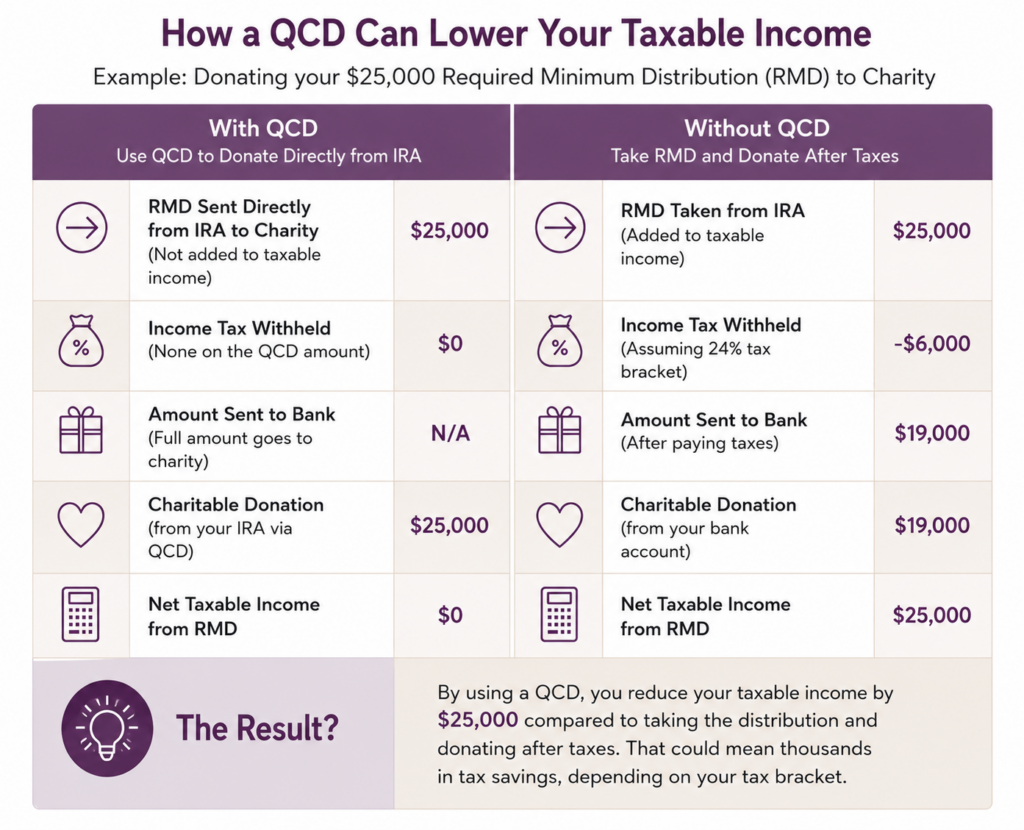
This example is provided for educational purposes only and is based on assumed facts, including a 24% federal income tax bracket. It is not intended to represent any actual investor experience or predict future tax outcomes. Tax consequences vary based on individual circumstances, applicable tax laws, and other factors. Consult a tax professional regarding your specific situation.
Benefits of a QCD
A QCD can provide several potential benefits. It may be a suitable giving strategy for donors who:
- Are required to take a minimum distribution from an IRA, but don’t need the funds and would face increased tax liabilities if they took the distribution as income.
- Would like to reduce the balance in an IRA to lower future required minimum distributions.
- Have identified which charities they want to support with a donation.
- Would like to make a larger charitable gift than they could if they simply donated cash or other assets. The value of charitable gifts that can be deducted from a tax return usually ranges from 20 to 60 percent of the donor’s adjusted gross income. This AGI-based limit does not apply to QCDs, allowing donors to make larger gifts.
Giving Directly from Your IRA Is Surprisingly Simple
Many people assume making a Qualified Charitable Distribution involves complicated paperwork. But IRA custodians have streamlined the process.
For example, Charles Schwab offers an IRA check-writing feature that allows eligible account holders to write checks directly from a designated IRA checkbook to qualified charities. The amount is deducted from the IRA, counts toward an eligible Required Minimum Distribution, and there is no additional fee to use the feature.
At Johnson Bixby, we help clients understand how this process works, coordinate cash availability within the IRA when needed, and ensure charitable giving fits within their broader financial and tax strategy.
To learn more about using an IRA checkbook for Qualified Charitable Distributions, download our Guide to Using Your Schwab IRA QCD Checkbook for step-by-step instructions.
Is a QCD Right for You?
A Qualified Charitable Distribution may be worth considering if you:
- Are age 70½ or older.
- Give regularly to qualified charitable organizations.
- Want to satisfy all or part of your Required Minimum Distribution.
- Take the standard deduction and look for a more tax-efficient way to give.
- Want to reduce taxable income while supporting causes you care about.
As with any tax strategy, the rules may have nuance depending on your specific situation. Working with both your financial planner and tax professional can help ensure your gifts are completed correctly and aligned with your overall financial plan.
QCDs are subject to IRS eligibility requirements, annual limits and charitable-recipient restrictions. Not all charitable organizations qualify to receive QCDs, and improper processing may affect the tax treatment of the distribution.
For more about our Tax Planning and Strategies services, visit: https://johnsonbixby.com/tax-strategies-and-planning/.
Frequently Asked Questions
What is a Qualified Charitable Distribution (QCD)? A Qualified Charitable Distribution is a direct transfer from an eligible IRA to a qualified public charity. For eligible taxpayers, the distribution is excluded from taxable income and may satisfy part or all of an annual Required Minimum Distribution (RMD).
At what age can I make a Qualified Charitable Distribution? You become eligible to make a QCD beginning at age 70½, even if you are not yet required to take Required Minimum Distributions.
What is the annual QCD limit? The annual limit is adjusted for inflation. For 2026, individuals may contribute up to $111,000 directly from an IRA through Qualified Charitable Distributions.
Can I make a QCD to any nonprofit? No. QCDs generally must be made to qualified public charities recognized under IRS rules. Certain organizations, including donor-advised funds and most private foundations, are not eligible recipients.
Can I simply write a personal check to charity? A personal check does not qualify as a QCD. The funds must come directly from the IRA to the qualified charity, either through your custodian or an approved IRA check-writing feature.
Do I need to tell my tax preparer about my QCD? Yes. Although your IRA custodian reports the distribution, your tax preparer needs to know the total amount of your Qualified Charitable Distributions so they can be reported correctly on your tax return.





































0 Comments