

What one student’s research revealed about preparing financially for higher education.
Most families (and students) think they’ve fully budgeted for college until they start to see the extra expenses adding up. It might be plane fares to help their student move into the dorm, the costs of the first parents’ weekend where the local hotels are at their highest rates or the final bill for buying all the items to help furnish a new dorm room.
That’s why, back in January of 2025, when we were approached by a Camas High School student, Yugg Nanavati, who asked for a mentor to help him create a research project in the financial planning industry, we agreed that this was an important topic to explore.
Yugg is an impressive student with a heartwarming smile and endless energy. He plans to major in finance. As he was applying for various colleges, he felt like this topic would be very relevant for his future financial success. His senior project, “The Real Cost of College,” is the result of many hours of research, personal interviews, analyzing 500 survey responses from high schoolers, current college students and graduates and collecting information from professional resources on our team.
Yugg divided his survey participants into three groups: High School Students and their families, Current College Students and Parents, and College Graduates and their families.
Among these groups, the main findings were that no group was fully prepared.
- High schoolers underestimate the costs consistently
- Current students miss financial planning for housing and fees
- Graduates missed long-term repayment planning
Why This Research Matters
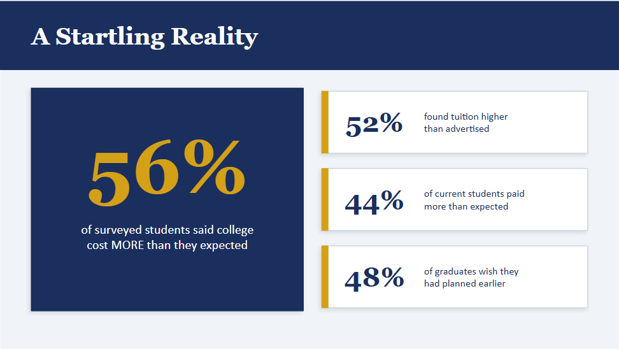
Yugg specifically looked at How Hidden Expenses Shape Student Financial Readiness and found some very interesting insights. Quite significantly, he found that 52% of students currently in college reported that tuition was higher than what they had expected. Fifty-six percent of these respondents reported that college costs are more than they expected even after accounting for tuition, room and board, which validates the belief that many families begin their college experience without a complete picture of the expected total costs.
Four Key Financial Blind Spots
What contributed to this gap? Yugg’s research found there were four elements to the challenges facing families paying for students in college:
College costs are often misunderstood by students and families.
Pro tip: Families should think about building a four-year cash flow plan that includes both tuition and the less obvious expenses that accumulate throughout college. Families should also plan to have conversations with their students on a regular basis asking for what new activities or expenses may be on the horizon to adjust the plan as needed.
Public knowledge of budgeting for higher education is limited.
Pro Tip: Seek as much information as you can on financial planning for college and have deeper conversations around expectations of college life with specific focus on the details. This is also where visiting a CFP® professional early in the process can be very helpful.
Indirect costs are routinely overlooked.
These include include textbooks, travel, meal plan overruns and scholarship non-renewals (the student being offered a scholarship for the first year and then assuming it will be given again every year.)
Pro Tip: Other potential costs to consider when planning for college: supplies for the dorm room, family hotel stays and activities, fraternity or sorority fees, technology such as purchasing a laptop or phone upgrade, moving expenses such as renting a truck to live off campus, internship or study abroad expenses, clothing for a different climate, parking/car/ride-share expenses, industry specific exams or professional associations your student may want to join. And don’t forget to include inflation. The list goes on.
Poor financial planning can lead to over-reliance on loans and long-term debt.
Pro Tip: For graduates, long-term repayment planning can be very helpful so that student loan choices are made intentionally. Many students regret that they were not more thoughtful in this planning and graduated with higher student loan balances than they expected. It’s important to talk openly with your family about any student loans that will be needed. The goal is for everyone to understand how much debt to expect, who will be responsible for it and how the debt will be repaid.
What Families May Want to Consider
Yugg concluded that even a small amount of targeted education can shift how families plan and his data supports it. Most importantly, the information gap isn’t about intelligence, it’s about access to the right information at the right time. His reminder is that a college education involves far more costs than tuition alone: room, board, textbooks, transportation and personal expenses add up fast. He also determined that Certified Financial Planner® professionals are underutilized resources. Families that consult a CFP® professional early may benefit from additional guidance and planning resources when evaluating college funding decisions.
We were excited to work with Yugg and are very proud of the work he did on his research project. I looked forward to our regular meetings and hearing about his insights and progress on his project. Most of all, I resonated with his passion for wanting to help other families plan for college to achieve the best financial outcome.
Whether your child is entering high school or preparing to submit college applications, understanding the full cost of higher education can help you make more informed financial decisions. Working with a CFP® professional early in the process may help families prepare for both the expected—and unexpected—expenses ahead.





































0 Comments