

We recently hosted Jon Nicolazzo with Capital Group, who shared timely insights from their 2026 Investing Outlook publication.
After three consecutive years of double-digit stock market returns, it’s understandable that many investors feel both confident and cautious.
One of the most compelling insights from this year’s outlook is this:
1. If You’re Sitting on Excess Cash, It May Be Time to Reconsider
With the Federal Reserve expected to cut interest rates in 2026, history suggests that both stocks and bonds have often benefited —particularly when rates were coming down and the economy was still growing.
When rates fall:
- Borrowing becomes cheaper
- Businesses and consumers tend to spend more
- Bond prices typically rise
- Equity markets often respond positively
Historically, during Fed easing cycles that did not coincide with recession, stocks and bonds delivered strong returns — while cash lagged.
That doesn’t mean abandoning liquidity entirely. Cash plays an important role for:
- Short-term spending needs
- Emergency reserves
- Known upcoming expenses
But excess cash sitting in money market funds for “someday” may quietly become a drag if markets respond favorably to rate cuts.
The question isn’t whether to hold cash. It’s whether your cash allocation still matches your goals and time horizon.
If you’re holding more cash than your plan requires — or simply aren’t sure — it may be a good time to talk with your financial planner about whether your current allocation still reflects where you want to go and what 2026 may bring.
Beyond rate policy, here are four additional themes shaping 2026:
2. Company Profits Are Expected to Rebound Globally
After tariff uncertainty and policy disruption clouded earnings expectations in 2025, this year is shaping up differently.
Consensus estimates point to:
- Strong earnings growth in emerging markets
- Continued growth in U.S. corporate earnings
- Stabilization in Europe
Lower interest rates, government stimulus, and reduced trade uncertainty are all contributing to a more constructive earnings outlook.
Why does this matter?
Over time, stock prices tend to follow earnings growth. Expanding profits can support market gains — and successful stocks may broaden beyond just mega-cap technology names.
3. AI: Bubble, Boom — or Both?
Artificial intelligence continues to dominate headlines, and comparisons to the late 1990s dot-com era are everywhere. But there’s an important distinction:
In the late 1990s, stock prices far outpaced earnings growth.
Today, many companies investing heavily in AI are generating real, substantial profits. Earnings growth has largely kept pace with rising market values. In addition, today’s dominant firms are well-capitalized and financially resilient — very different from the speculative startups of the dot-com era.
Could enthusiasm eventually run too hot? Possibly. But at this stage, AI appears to be a powerful secular growth driver rather than pure speculation.
4. Policy Stimulus Could Support the Global Economy
Governments around the world are responding to slower growth and trade friction with stimulus measures:
- The U.S. is easing rates and incentivizing manufacturing
- Europe is investing heavily in infrastructure and defense
- Japan and parts of Asia are pushing corporate reforms to unlock shareholder value
Stimulus carries risks — including rising debt and inflation pressures — but it also has the potential to extend economic momentum.
This reinforces the idea of what some call the “and market”:
- U.S. and international
- Growth and value
- Cyclical and secular
- Stocks and bonds
Balance and diversification matter more than bold predictions.
5. There Are Always Reasons Not to Invest
Pandemics. Wars. Inflation spikes. Tariffs. Political shifts.
No matter how significant the event, time after time, markets have worked through turbulence and moved higher over long periods. The path is never smooth — but history shows resilience. The lesson isn’t that markets only go up. They don’t. The lesson is that waiting for perfect clarity has historically been costly.
The chart below highlights major market declines throughout history and the recoveries that came after. The downturns were real. The headlines were alarming. The uncertainty felt justified. But so were the rebounds.
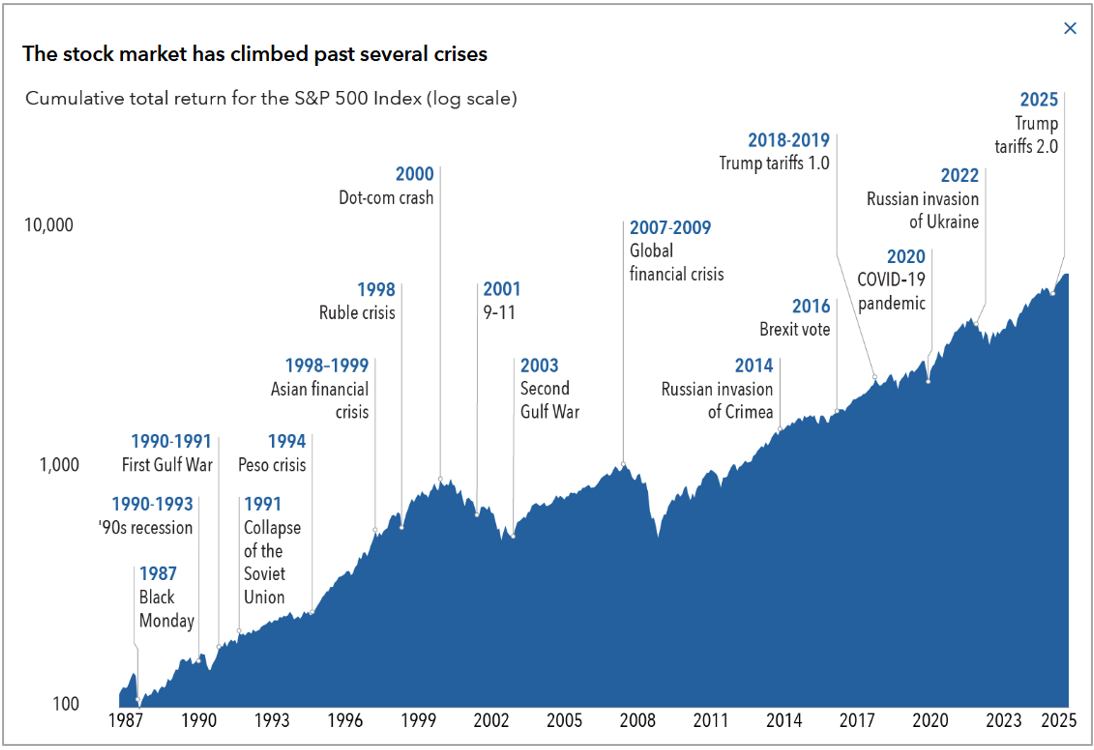
Source: Capital Group, Standard & Poor’s. As of December 31, 2025. Data is indexed to 100 as of January 1, 1987, based on cumulative total returns for the S&P 500 Index.
What This Means for Investors in 2026
This isn’t about predicting the next 12 months.
It’s about:
- Aligning your allocation with your long-term goals
- Ensuring excess cash isn’t unintentionally undercutting growth
- Maintaining diversification across sectors, geographies, and asset classes
- Staying disciplined in the face of headlines
If you’re holding surplus cash because the last few years have felt uncertain, it may be worth talking with your financial planner and revisiting whether that allocation still serves your broader plan.
Heidi Johnson Bixby, CFP®, is a CERTIFIED FINANCIAL PLANNER® professional and CEO and President at Johnson Bixby. Along with working directly with clients, she leads the firm’s long-term vision and mentors the financial planning team, helping ensure clients benefit from a thoughtful and coordinated planning approach. In her work with clients, she focuses on areas that continue to differentiate the firm including life transitions, retirement income design, tax planning strategies, and estate and charitable planning.



































0 Comments